⚡ UP PGT Physics Syllabus PDF Download — Click Here ⚡
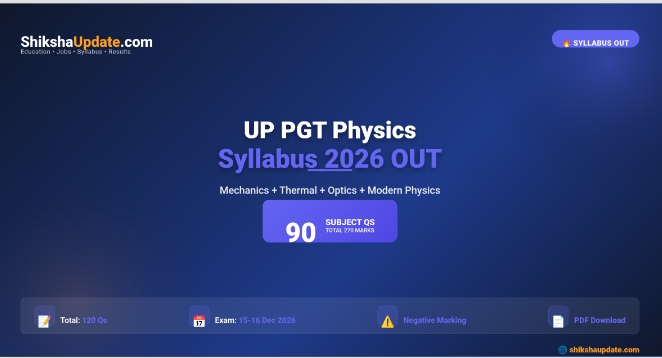
UP PGT Physics Syllabus 2026 OUT: Best PDF Download Link, 90 Questions
Subject: Physics
Total Qs: 120
Subject Qs: 90
Status: OUT
UP PGT Physics Syllabus 2026 UPESSC ne official website pe release kar diya hai. Is article me aapko poora subject-wise syllabus, exam pattern, Mechanics se lekar Modern Physics tak sabhi topics aur best books ki complete list milegi. Agar aap UP PGT Physics ka form bhar chuke ho, to ye syllabus aapke liye bible hai — isse bahar ka kuch nahi aayega.
📌 UP PGT Physics Syllabus 2026: Exam Pattern
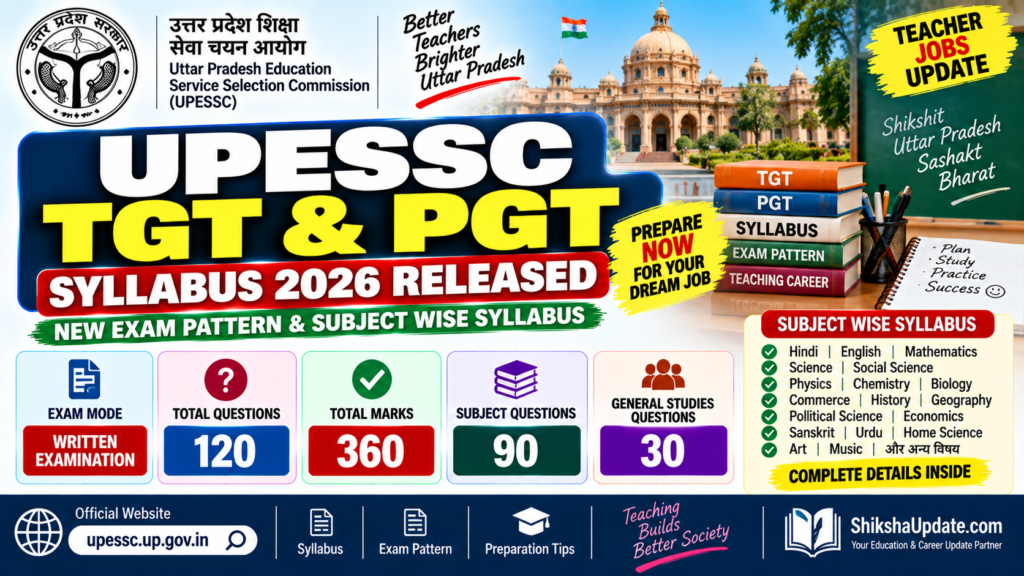
| Subject Section (Physics) | 90 Questions | 270 Marks |
|---|---|
| General Studies | 30 Questions | 90 Marks |
| Total Questions | 120 Questions | 360 Marks |
| Negative Marking | Yes, 1 Mark Deducted |
| Duration | 2 Hours (120 Minutes) |
| Interview | 40 Marks |
📚 UP PGT Physics Syllabus 2026: Topic-wise Details
- Unit 1 — Mechanics: Physical World and Measurement, Vector Algebra, Scalar & Vector Product, Vector Identities, Vector Calculus (Line, Surface, Volume Integrals), Gauss and Stokes Theorems, Centre of Mass, Rotating Frame of Reference, Coriolis Force, Motion of Rigid Body, Moment of Inertia, Parallel & Perpendicular Axis Theorems, Angular Momentum, Torque, Central Force, Kepler’s Laws, Satellite Motion, Geostationary Satellite, Galilean Transformation, Time Dilation, Mass-Energy Equivalence, Streamline & Turbulent Flow, Reynolds Number, Stokes’ Law, Poiseuille’s Formula, Bernoulli’s Theorem, Surface Tension, Stress & Strain, Hooke’s Law, Elastic Moduli, Poisson’s Ratio.
- Unit 2 — Thermal Physics: Concept of Heat, Zeroth Law, First Law of Thermodynamics, Internal Energy, Isothermal & Adiabatic Processes, Second Law, Entropy, Carnot Cycle, Carnot Engine, Maxwell’s Thermodynamic Relations, Clausius-Clapeyron Equation, Porous Plug Experiment, Joule-Thomson Effect, Kinetic Theory of Gases, Maxwell Distribution Law, Average/RMS/Most Probable Velocity, Degrees of Freedom, Law of Equipartition of Energy, Specific Heat of Gases, Mean Free Path, Transport Phenomena, Black Body Radiation, Stefan’s Law, Newton’s Law of Cooling, Wien’s Law, Rayleigh-Jeans Law, Planck’s Law, Solar Constant.
- Unit 3 — Waves and Oscillations: Oscillations, Simple Harmonic Motion, Progressive and Stationary Waves, Damped Harmonic Motion, Forced Oscillations and Resonance, Sharpness of Resonance, Wave Motion, Plane and Spherical Waves, Superposition of Waves, Fourier Analysis of Periodic Waves (Square & Triangular Waves), Phase Velocity and Group Velocity, Beats.
- Unit 4 — Optics: Cardinal Points of Coaxial System, Combination of Thin Lenses, Eyepieces (Ramsden and Huygens), Huygens’ Principle, Sustained Interference, Young’s Double Slit Experiment, Division of Amplitude and Wavefront, Fresnel’s Biprism, Newton’s Rings, Michelson’s Interferometer, Diffraction by Straight Edge, Single/Double/Multiple Slits, Rayleigh Criterion, Resolving Power of Grating and Optical Instruments, Polarization (Linear, Circular, Elliptical), Brewster’s Law, Huygens’ Law of Double Refraction, Optical Rotation, Polarimeter, Lasers (Temporal & Spatial Coherence, Spontaneous & Stimulated Emission, Ruby and Helium-Neon Lasers).
- Unit 5 — Electricity and Magnetism: Gauss’s Law and Applications, Electric Potential, Capacitors and Capacitance, Kirchhoff’s Laws, Wheatstone Bridge, Biot-Savart Law, Ampere’s Circuital Law, Magnetic Induction and Field Intensity, Magnetic Field on the Axis of a Circular Coil, Electromagnetic Induction, Faraday’s and Lenz’s Laws, Self and Mutual Inductance, Alternating Current, L-C-R Circuit, Series and Parallel Resonance Circuits, Quality Factor (Q-Factor), AC Bridges, Maxwell’s Equations and Electromagnetic Waves, Transverse Nature of EM Waves, Poynting Vector, Dia-, Para-, Ferro-, Antiferro- and Ferrimagnetism, Hysteresis.
- Unit 6 — Modern Physics: Bohr’s Theory of Hydrogen Atom, Electron Spin, Pauli’s Exclusion Principle, Optical and X-ray Spectra, X-ray Diffraction, Bragg’s Law, Spatial Quantization, Stern-Gerlach Experiment, Vector Atom Model, Spectral Terms, Fine Structure of Spectral Lines, j-j and L-S Coupling, Zeeman Effect, Raman Effect, Photoelectric and Compton Effects, de Broglie Waves, Wave-Particle Duality, Uncertainty Principle, Concepts of Quantum Mechanics, Schrödinger Wave Equation, Eigenvalues, Lattice, Specific Heat, Energy Bands, Kronig-Penney Model, Energy Gap, Metals/Semiconductors/Insulators, Variation of Fermi Level with Temperature, Effective Mass, Radioactivity, Nuclear Binding Energy, Semi-Empirical Mass Formula, Nuclear Fission and Fusion, Elementary Reactor Physics, Elementary Particles, Particle Accelerators (Cyclotron, Linear Accelerator), Elementary Concept of Superconductivity.
🎯 UP PGT Physics Syllabus 2026: Preparation Strategy
- NCERT pehle: Class 11-12 NCERT Physics padho. Basic concepts clear ho jayenge.
- H.C. Verma zaroor padho: Concepts of Physics (Part 1 & 2) sabse authentic book hai.
- Numericals roz solve karo: Physics me numericals zyada aate hain. Formula notebook banao.
- Modern Physics alag se: 20-25 questions aate hain. Isko halke me mat lo.
- Previous Year Papers: Last 5 saal ke papers solve karo. Pattern samajh me aa jayega.
- Daily 2 hours Subject + 1 hour NCERT + 1 hour PYQ.
📖 UP PGT Physics Syllabus 2026: Best Books
| Complete Guide | Sahitya Bhawan UP TGT-PGT Physics, Arihant UP PGT Physics Guide |
|---|---|
| Concepts of Physics | H.C. Verma (Part 1 & 2) |
| NCERT Physics | Class 11 & 12 (Part 1 & 2) |
| Problems in Physics | S.S. Krotov, I.E. Irodov |
| Modern Physics | Modern Physics by R. Murugeshan, Concepts of Modern Physics by A. Beiser |
🔗 UP PGT Related Syllabus (Science Group)
| UP PGT Chemistry Syllabus | Click Here |
|---|---|
| UP PGT Biology Syllabus | Click Here |
| UP PGT Maths Syllabus | Click Here |
| UP PGT Complete Syllabus (Master PDF) | Click Here |
| UP PGT Preparation Strategy 2026 | Click Here |
❓ UP PGT Physics Syllabus 2026 FAQs
Q1. UP PGT Physics Syllabus 2026 me kya-kya topics hain?
Ans: Mechanics, Thermal Physics, Waves and Oscillations, Optics, Electricity and Magnetism, aur Modern Physics ke topics shamil hain.
Q2. UP PGT Physics me kitne questions aate hain?
Ans: Subject section me 90 questions (270 marks) aur General Studies se 30 questions (90 marks). Total 120 questions, 360 marks.
Q3. UP PGT Physics ke liye best books kaunsi hain?
Ans: NCERT Class 11-12 Physics, H.C. Verma (Concepts of Physics), aur Sahitya Bhawan UP TGT-PGT Physics best books hain.
Q4. UP PGT Physics me negative marking hai?
Ans: Haan, 2026 se UP PGT me negative marking laagu hui hai. Har galat jawab pe 1 mark katega.
Q5. UP PGT Physics ka exam kab hoga?
Ans: UP PGT 2026 ka exam 15-16 December 2026 ko offline (OMR-based) mode me hoga.
Official updates ke liye UPESSC ki official website par visit karein. Ye bhi padhein: Latest Jobs, Admit Card, Result, Syllabus.
📢 ShikshaUpdate से जुड़े रहें